Peptides and the skin: what the literature says about GHK-Cu
By Redactie PEPTID8 · 30 juli 2026 · 7 min read
Of the peptides encountered in dermatological research, GHK-Cu is the most extensively documented. It is a tripeptide, three amino acids, that binds a copper ion, and it has been present in the literature since the 1970s. Below is what has been published about it, from its initial description in serum to recent years' gene expression data. And, just as importantly: what explicitly does not follow from this.
What GHK-Cu is
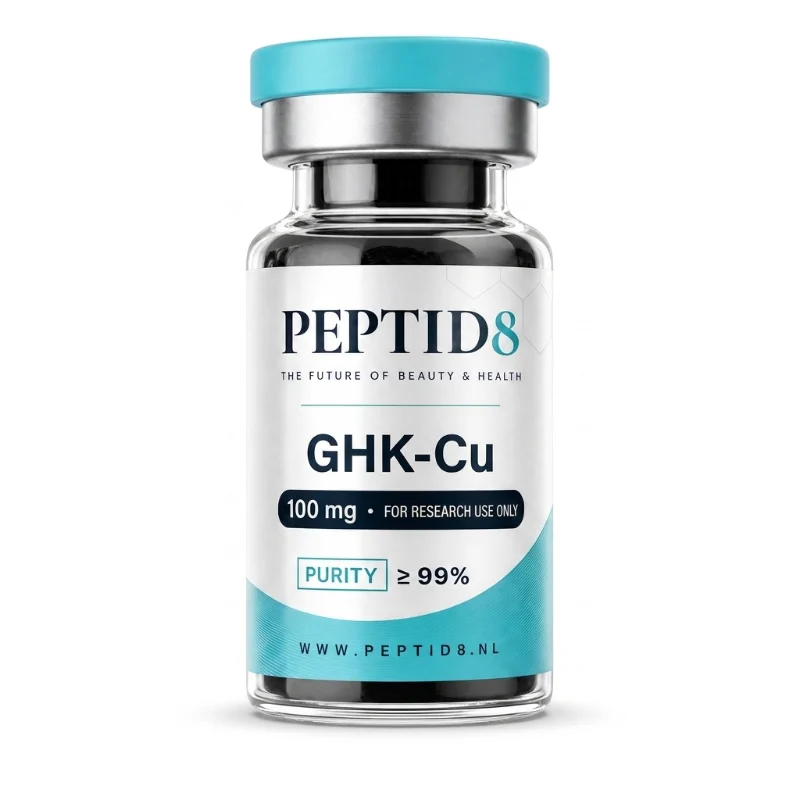
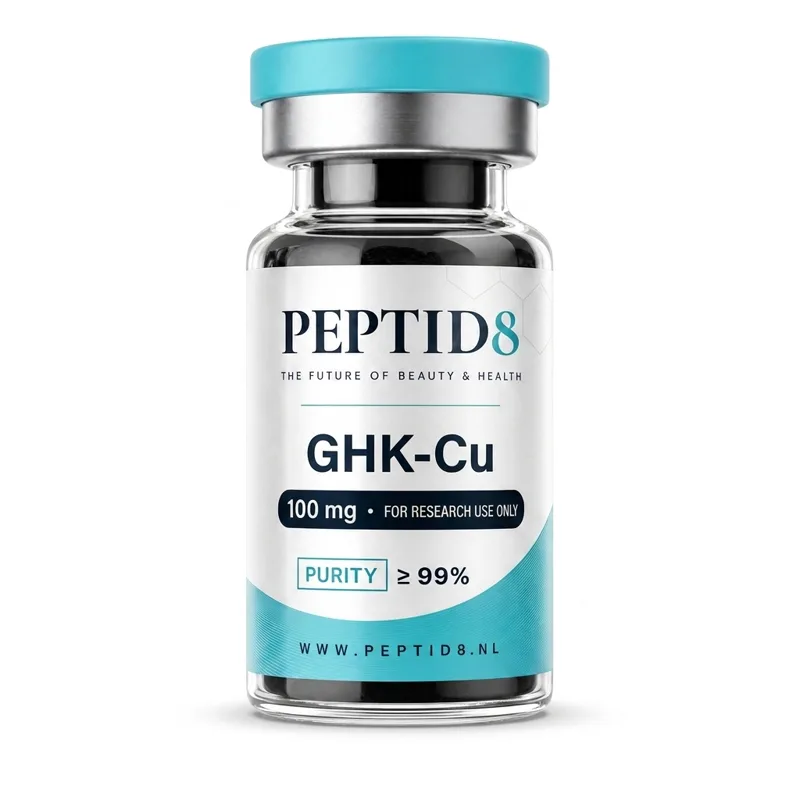
GHK stands for the sequence glycine-histidine-lysine (Gly-His-Lys). Together, these three amino acids form a structure capable of binding a copper(II) ion with high affinity; the complex is called GHK-Cu and, according to PubChem, has a molecular mass of around 401 g/mol. As a lyophilisate, the powder is blue. This color originates from the copper complex itself, not from an additive.
The compound occurs naturally in human plasma, and its concentration declines with age. The review article by Pickart and Margolina (2018) cites approximately 200 ng/ml around age twenty and approximately 80 ng/ml around age sixty. This observation initially attracted researchers' attention, but a lower plasma concentration in itself indicates nothing about cause and effect.
For those who first want to understand how peptides are structured in general and why a chain of three amino acids already possesses distinct chemistry, read what are peptides.
A literature in three stages
The publication history of GHK can be roughly divided into three phases.
The discovery. Pickart and Thaler (1973) described a tripeptide in human serum that, in their experimental setup, prolonged the survival of cultured liver cells. Only later did it become clear that copper binding plays a central role in how the molecule behaves in cell models.
The fibroblast research. Maquart and colleagues (1988) measured an increase in collagen synthesis in fibroblast cultures following the addition of the copper complex. Fibroblasts are the cells that produce the extracellular matrix in connective tissue, making them a logical model for this question. Subsequent studies also examined enzymes that degrade collagen; Pickart (2008) grouped this work under the heading of tissue remodeling. The review article by Pickart and colleagues (2015) summarizes this line of research: in the described models, GHK stimulated both the synthesis and degradation of collagen and glycosaminoglycans. This is not a one-way street, but remodeling—synthesis and degradation occurring simultaneously.
The gene expression data. In their 2018 review, Pickart and Margolina discuss expression data from the Connectivity Map, a public database cataloging how cultured cell lines respond to a wide range of substances. According to their analysis, GHK shifts the expression of thousands of genes, including genes involved in matrix construction and antioxidative processes.
What gene expression data do and do not show
Expression data sound compelling due to their volume, but they measure something specific: which messenger RNAs in a culture of a specific cell line increase or decrease following exposure to a substance. They do not indicate whether the corresponding protein is actually produced in greater quantities, whether the same occurs in tissue, or whether anything measurable results in a whole organism. Furthermore, the cell lines in such databases are largely tumor cell lines, not skin cells.
This does not render the data useless. It makes them hypothesis-generating: a list of signaling pathways that can be tested in subsequent models. When encountering a statement such as "GHK affects thousands of genes," it is prudent to ask: in which cells, at what concentration, and was it subsequently confirmed elsewhere?
The problem of the stratum corneum
A publication in BioImpacts (2025) is the most relevant in this context, as it discusses not only favorable findings but also the limitations. GHK is hydrophilic and charged, and the stratum corneum, the outermost layer of the skin, acts precisely as a barrier to such molecules. Additionally, the peptide can be degraded by peptidases in the skin. In a culture dish, a substance reaches the cells directly; in a skin model, it must first cross a barrier.
Citing only the favorable half of the literature leaves out the most challenging part.
This is also why a copper peptide percentage on a label says little on its own. The formulation as a whole determines what happens to the molecule.
KPV: another tripeptide, a different research question
In the same product category is KPV, the tripeptide lysine-proline-valine. KPV is the C-terminal fragment 11–13 of α-MSH, melanocyte-stimulating hormone. Research into it originates from a different angle than that into GHK-Cu: not the extracellular matrix, but inflammation-related signaling.
Dalmasso and colleagues (2008) described that KPV enters intestinal epithelial cells via the peptide transporter PepT1. In cell models, they measured an inhibition of NF-κB and MAP kinase signaling, and in mouse models of chemically induced colitis, lower expression of pro-inflammatory cytokines. This is intestinal research, not skin research; above all, it demonstrates that two tripeptides in the same category can address very different research questions.
Where the research ends
Findings in cell models and animal models do not constitute evidence of what occurs in humans. The step from a cell culture to a clinical outcome is substantial, and for most of what is described above, that step has not been taken. Furthermore, a substantial portion of the review literature on GHK originates from the same author. This says nothing about the quality of the work, but it does reflect on how independent the overall picture is.
PEPTID8 supplies GHK-Cu as research material. We make no statements regarding cosmetic or medical applications; the literature is presented here for reference, not as substantiation for any claim.
Research material and cosmetics are two separate things
The shop also carries cosmetic serums containing copper peptides. These are distinct products: formulated ready-to-use, with separate labeling, and governed by cosmetic regulations. They are separate from the lyophilized research material, and we likewise make no statements regarding what the serums do to the skin. Those reading the literature above should therefore not interpret it as a description of a serum, nor vice versa.
Storage and reconstitution
GHK-Cu is supplied as a lyophilisate and, unopened, should be stored dry, protected from light, and at −20 °C. After reconstitution, the vial should be kept at 2–8 °C and protected from light, within the timeframe indicated on the product page; copper peptides are light-sensitive. General guidelines, from condensation formation to aliquoting and freezing, can be found in storing peptides.
What you do receive from us
Where a report is available, an analysis by BTLabs with two measurements: an HPLC purity determination and an FTIR spectrum confirming identity. The report specifies the lot number and includes a verification link allowing you to verify authenticity directly with the laboratory; all published reports are available on the certificates page. How to interpret such a report is explained in purity, HPLC, and mass spectrometry.
For a compound that coordinates a metal ion, this identity measurement is especially relevant: the complex can occur in different ratios of peptide to copper. The report specifies what was present in the tested vial. It does not constitute instructions for use.
Frequently asked questions
Why is GHK-Cu blue?
The blue color originates from the copper(II) ion in the complex. The free peptide GHK is white; once it coordinates copper, the powder as well as the solution takes on a blue hue. A distinctly different color is reason to review the lab report.
Is GHK the same as GHK-Cu?
No. GHK is the tripeptide without metal; GHK-Cu is the complex with copper. Both forms appear in the literature, but most research on the matrix and gene expression pertains to the copper complex. When reviewing a study, note which form was investigated.
Does research in fibroblast cultures indicate anything about human skin?
Not directly. A fibroblast culture is a simplified model without a stratum corneum, blood vessels, or immune cells. It provides findings regarding mechanisms, not conclusions about what occurs in living tissue.
Are the cosmetic serums the same as the research material?
No. The serums are ready-to-use cosmetic formulations with distinct compositions and labeling. The lyophilized GHK-Cu is research material for laboratory use. We make no efficacy claims for either.
References
- Pickart L, Thaler MM. Tripeptide in human serum which prolongs survival of normal liver cells and stimulates growth in neoplastic liver. Nature New Biology, 1973. https://pubmed.ncbi.nlm.nih.gov/4349963/
- Maquart FX et al. Stimulation of collagen synthesis in fibroblast cultures by the tripeptide-copper complex glycyl-L-histidyl-L-lysine-Cu2+. FEBS Letters, 1988. https://pubmed.ncbi.nlm.nih.gov/3169264/
- Pickart L. The human tri-peptide GHK and tissue remodeling. Journal of Biomaterials Science, Polymer Edition, 2008. https://pubmed.ncbi.nlm.nih.gov/18644225/
- Pickart L, Vasquez-Soltero JM, Margolina A. GHK Peptide as a Natural Modulator of Multiple Cellular Pathways in Skin Regeneration. BioMed Research International, 2015. https://pubmed.ncbi.nlm.nih.gov/26236730/
- Pickart L, Margolina A. Regenerative and Protective Actions of the GHK-Cu Peptide in the Light of the New Gene Data. International Journal of Molecular Sciences, 2018. https://pubmed.ncbi.nlm.nih.gov/29986520/
- Dalmasso G, Charrier-Hisamuddin L, Nguyen HT, Yan Y, Sitaraman S, Merlin D. PepT1-mediated tripeptide KPV uptake reduces intestinal inflammation. Gastroenterology, 2008. https://pubmed.ncbi.nlm.nih.gov/18061177/