MOTS-c: the mitochondrial peptide in research
By Redactie PEPTID8 · 5 oktober 2026 · 7 min read
Most proteins in a cell are encoded by the DNA in the cell nucleus. However, mitochondria possess their own small genome, which was found to contain shorter reading frames than was long assumed. MOTS-c is one of the best-known products of these: a short peptide that has been studied in cell and animal models since 2015 as a signaling molecule between the mitochondrion, the nucleus, and metabolism. This article outlines what is known, where current knowledge ends, and what a lab report for MOTS-c does and does not reveal.
What MOTS-c is
The name stands for mitochondrial open reading frame of the 12S rRNA type-c. It is a peptide of 16 amino acids, encoded by a short reading frame of 51 base pairs within the gene for the 12S ribosomal RNA (MT-RNR1) in mitochondrial DNA. The review article by Wan and colleagues (2023) describes how comparisons with sequence databases indicated a mitochondrial origin and ruled out an origin from the nuclear genome.
Notably, according to current understanding, the peptide is translated in the cytoplasm, not within the mitochondrion itself. The mitochondrial genetic code differs in several points from the standard code; as a result, the same segment of RNA yields a full peptide outside the mitochondrion. MOTS-c thus belongs to the group of mitochondrial-derived peptides (MDPs), which also includes humanin.
A peptide from the mitochondrial genome that delivers its signal outside the mitochondrion.
The original study and the AMPK signaling pathway
The first comprehensive description came from Lee and colleagues (2015) in Cell Metabolism. In cell models, MOTS-c inhibited the folate pathway and the associated synthesis of purines. Consequently, AICAR accumulated—an intermediate product of that purine synthesis—leading to the activation of AMPK. AMPK (AMP-activated protein kinase) is considered a central cellular energy sensor: it responds to energy deficits and adjusts processes such as glucose uptake and fatty acid oxidation.
Skeletal muscle emerged in that study as the primary target tissue. In mice on a high-fat diet, the research team measured less weight gain and less insulin resistance compared to control animals. Additionally, the team examined age-related insulin resistance in older mice. A later review by Lee, Kim, and Cohen (2016) placed these findings into a broader framework of muscle and fat metabolism.
From mitochondrion to nucleus
Kim and colleagues (2018) added a second layer. Under metabolic stress, such as glucose restriction or oxidative stress, MOTS-c translocated to the nucleus in cell models. This translocation depended on AMPK. In the nucleus, the peptide influenced the expression of a broad set of genes, including genes with a so-called antioxidant response element, in concert with stress-responsive transcription factors such as NRF2.
The picture emerging from this: a mitochondrially encoded signal that directly participates in regulating nuclear gene activity. Communication between the nucleus and the mitochondrion was long studied primarily in the reverse direction; MOTS-c is one of the clearest examples of a signal traveling the other way.
Metabolic models and aging in animal models
After 2015, MOTS-c was investigated in diverse preclinical models, ranging from insulin resistance and high-fat diets to cardiac, bone, and muscle tissue. Gao and colleagues (2023) discuss a large part of the metabolic work; Wan and colleagues (2023) compile findings related to stress, metabolism, and aging. Both reviews demonstrate that most data come from mice and cell cultures, featuring markedly different study designs. This makes cross-study comparisons challenging.
For aging research, MOTS-c is of interest for two reasons. First, metabolic regulatory systems such as AMPK and insulin sensitivity change with age, which is precisely the domain where MOTS-c has been studied in models. Second, there is a genetic clue from a human population: Fuku and colleagues (2015) described in Aging Cell a variant in the mitochondrial DNA (m.1382A>C) that changes one amino acid in MOTS-c and was found more frequently in a Japanese population among individuals who reached exceptional longevity. This is a statistical association, not an established mechanism.
The state of human research
Human research on MOTS-c is largely observational: researchers measure the concentration of the endogenous peptide in blood or muscle tissue and look for correlations with age, insulin sensitivity, or physical activity. An example is the study by Dieli-Conwright and colleagues (2021) in Scientific Reports, in which MOTS-c was measured in plasma among breast cancer survivors participating in an endurance and resistance training program. Such studies provide insight into how the endogenous peptide correlates with physiological states, not into what synthetic MOTS-c would do in humans.
Crucial for context: MOTS-c is not a medicine and is not approved for any human application. Furthermore, measurement methods for circulating MOTS-c vary among laboratories, making absolute values from different studies difficult to compare directly.
MOTS-c is often mentioned in the literature alongside other topics in energy metabolism. As a coenzyme, NAD+ is closely linked to the same questions regarding mitochondria and aging; see the article NAD+ in research and the product page NAD+. 5-Amino-1MQ is a small molecule studied in preclinical research as an inhibitor of the enzyme NNMT, which is involved in nicotinamide metabolism.
Reading the lab report
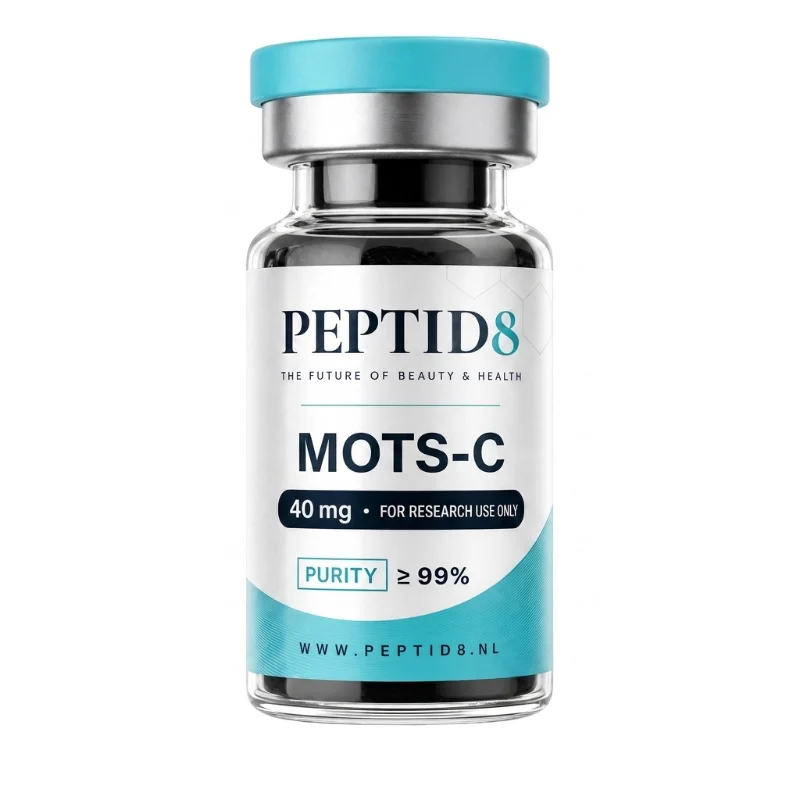
With a research peptide like MOTS-c, the first question is whether the vial contains what the label indicates. The product page provides, where available, the BTLabs report with two measurements. The HPLC determination indicates purity: the proportion of the main signal relative to all detected components. The FTIR identification confirms identity by comparing the infrared spectrum of the sample to that of a reference.
Verify that the lot number on the report matches the lot number on the vial, and use the verify link to cross-check the report with the laboratory. Further explanation can be found in purity, HPLC and mass spectrometry and on the certificates page. What the report does not state: how the product should be used. It is a chemical analysis of the substance, not usage instructions.
Frequently Asked Questions
Does MOTS-c originate from mitochondrial DNA?
Yes. It is encoded by a short open reading frame within the 12S rRNA gene of the mitochondrial genome. According to current insights, it is translated in the cytoplasm. In studies, it has subsequently also been detected in the nucleus and in circulation.
What is the relationship between MOTS-c and AMPK?
In the study by Lee and colleagues (2015), MOTS-c inhibited the folate pathway in cell models, causing AICAR to accumulate and activating AMPK. Kim and colleagues (2018) showed that the translocation of MOTS-c to the cell nucleus under metabolic stress was dependent on AMPK.
Has MOTS-c been studied in humans?
Primarily observational studies exist that measure the endogenous peptide in blood or muscle tissue. These do not provide information regarding the application of synthetic MOTS-c. The product is intended exclusively for laboratory research and not for human use.
What exactly does the lab report show?
The purity (HPLC) and identity (FTIR) of one specific lot, along with the corresponding lot number and a verify link. The report does not contain usage advice.
References
- Lee C et al., The mitochondrial-derived peptide MOTS-c promotes metabolic homeostasis and reduces obesity and insulin resistance, Cell Metabolism, 2015, https://pubmed.ncbi.nlm.nih.gov/25738459/
- Lee C, Kim KH, Cohen P, MOTS-c: A novel mitochondrial-derived peptide regulating muscle and fat metabolism, Free Radical Biology & Medicine, 2016, https://pubmed.ncbi.nlm.nih.gov/27216708/
- Kim KH et al., The Mitochondrial-Encoded Peptide MOTS-c Translocates to the Nucleus to Regulate Nuclear Gene Expression in Response to Metabolic Stress, Cell Metabolism, 2018, https://pubmed.ncbi.nlm.nih.gov/29983246/
- Fuku N et al., The mitochondrial-derived peptide MOTS-c: a player in exceptional longevity?, Aging Cell, 2015, https://pubmed.ncbi.nlm.nih.gov/26289118/
- Dieli-Conwright CM et al., Effect of aerobic and resistance exercise on the mitochondrial peptide MOTS-c in Hispanic and Non-Hispanic White breast cancer survivors, Scientific Reports, 2021, https://pubmed.ncbi.nlm.nih.gov/34413391/
- Gao Y et al., MOTS-c Functionally Prevents Metabolic Disorders, Metabolites, 2023, https://pubmed.ncbi.nlm.nih.gov/36677050/
- Wan W et al., Mitochondria-derived peptide MOTS-c: effects and mechanisms related to stress, metabolism and aging, Journal of Translational Medicine, 2023, https://pubmed.ncbi.nlm.nih.gov/36670507/