Epithalon (Epitalon): the tetrapeptide and telomere research
By Redactie PEPTID8 · 5 oktober 2026 · 8 min read
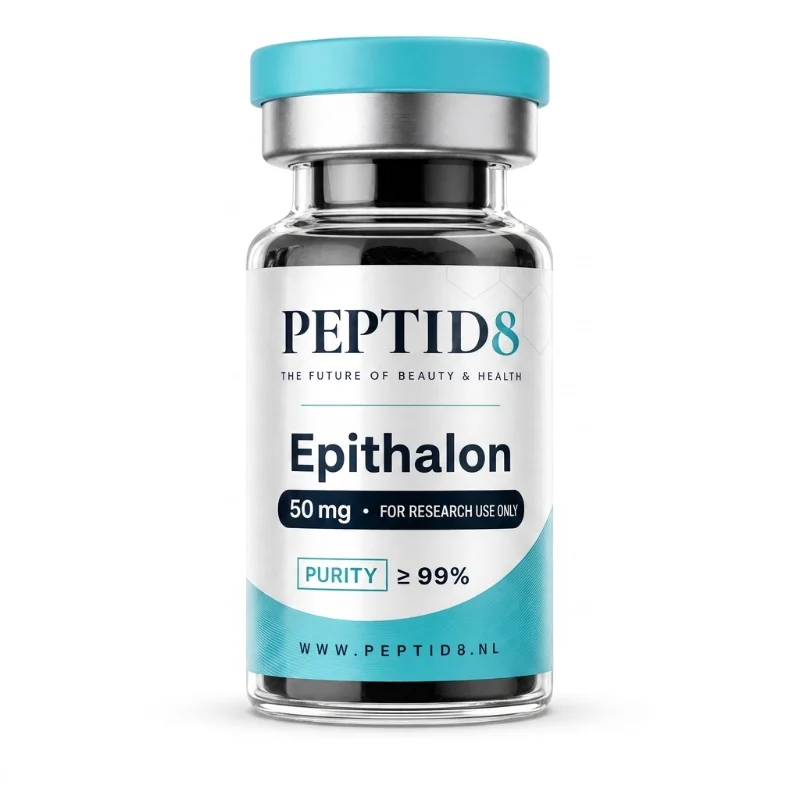
Epithalon, Epitalon, Epithalone, AEDG: four names for the same short peptide. It consists of only four amino acids and is primarily known from research into telomeres, the protective ends of chromosomes. Anyone searching the literature quickly encounters assertive claims. In this article, we outline what has been measured in cell and animal models, where the research originates, and why critical reading is especially important here.
Four amino acids: Ala-Glu-Asp-Gly
Epithalon is a tetrapeptide with the sequence alanine, glutamic acid, aspartic acid, glycine: in three-letter code Ala-Glu-Asp-Gly, in one-letter code AEDG. The review article by Araj and colleagues (2025) in the International Journal of Molecular Sciences lists Epitalon, Epithalon, and Epithalone as common spellings for this single molecule. With four residues, it is one of the smallest peptides studied in cellular senescence research; many well-known peptide hormones comprise dozens of amino acids.
A short, linear chain has practical implications for the laboratory. The peptide is relatively straightforward to produce via solid-phase synthesis and easy to verify using HPLC and an identity test such as FTIR or mass spectrometry. How these two analyses together establish identity and purity can be read in our article on purity, HPLC, and mass spectrometry.
From epithalamine to a synthetic tetrapeptide
The history does not begin with the tetrapeptide, but with epithalamine: a polypeptide extract from the bovine pineal gland (epiphysis). According to the review by Araj and colleagues (2025), early research into this extract was primarily led by Russian researchers V.K. Khavinson and V.N. Anisimov. Epithalon was subsequently designed based on the amino acid composition of epithalamine. Instead of a mixture with variable composition, researchers thus obtained a single defined, synthetic sequence.
This transition is relevant for anyone reading the literature. Studies with epithalamine and studies with Epithalon are not straightforwardly interchangeable: the extract contains multiple components, while the tetrapeptide is a single molecule. Therefore, check in each publication which substance specifically was investigated.
Khavinson later situated the tetrapeptide within a broader theory on short regulatory peptides. In a publication in Neuro Endocrinology Letters, Khavinson and colleagues (2005) described a model in which such peptides bind to double-stranded DNA, similar to transcription factors. That model is not universally accepted. The 2025 review also states that the precise mechanism of Epithalon remains uncertain.
Telomeres and telomerase: the background
Telomeres are repetitive DNA sequences at the ends of chromosomes. In most somatic cells, they shorten slightly with each cell division. After a certain number of divisions, the cell ceases to divide, a threshold known as the Hayflick limit. The enzyme telomerase can re-extend telomeres; its catalytic subunit is called hTERT. In most adult somatic cells, telomerase is barely active, whereas in stem cells and in many tumor cell lines, it is.
This last point dictates how one must interpret the literature. Telomerase activation is not an unambiguously favorable endpoint in cell biology: it is also one of the pathways by which tumor cells circumvent their division limit. Furthermore, a telomerase-independent pathway exists, ALT (alternative lengthening of telomeres), which is active in a subset of tumor cells.
What cell models measure
The most well-known early work is by Khavinson and colleagues (2003), published in the Bulletin of Experimental Biology and Medicine. Under the title "Epithalon peptide induces telomerase activity and telomere elongation in human somatic cells", they reported telomerase activity and telomere elongation in cultured human somatic cells following exposure to the peptide. A follow-up publication by the same group (2004) described cultured cells exceeding their typical division limit.
For the current state of knowledge, a recent cell study from outside the original research group is more significant. Al-Dulaimi and colleagues (2025) published a study design in Biogerontology involving both normal cells (fibroblasts and mammary epithelial cells) and two breast cancer cell lines. They measured telomere length using qPCR, hTERT mRNA expression, telomerase activity using a TRAP assay, and markers of ALT activity.
The findings: telomere length increased across all investigated cell lines. In normal cells, this was accompanied by increased hTERT expression and higher telomerase activity. In cancer cell lines, hTERT expression increased, but telomerase activity did not change significantly; instead, ALT activity primarily increased. The authors conclude that the peptide interacts with telomeres via different mechanisms depending on the cell type.
Telomere elongation in a culture dish indicates a mechanism, not an organism.
What animal models measure
In animal models, Epithalon has primarily been studied by Anisimov, Khavinson, and colleagues. In a study in Biogerontology (2003), they tracked female SHR mice from a young age until their natural death. Endpoints included food intake, estrous cyclicity, chromosome aberrations in bone marrow cells, lifespan, and spontaneous tumor development. In the exposed group, the authors reported fewer chromosome aberrations, an extended maximum lifespan, and lower incidence of leukemia, while total tumor incidence did not differ from the control group.
A second study by the same group, in the Russian-language journal Voprosy Onkologii (2005), used senescence-accelerated mouse strains (SAM) and compared Epithalon with melatonin. There too, estrous function and the survival of the longest-lived animals served as endpoints; no significant difference was found in tumor incidence.
Such animal studies are valuable as hypothesis-generating work, but have clear limitations: specific mouse strains, limited sample sizes, and an endpoint—lifespan—that is sensitive to housing conditions, diet, and statistical methodology.
Critical considerations
Examining the publications on Epithalon reveals a pattern: the vast majority originates from a single research group and affiliated institutes. This does not make the findings incorrect, but it does render them less robust than if multiple independent laboratories had observed the same outcomes. Points to consider:
- Independent replication is scarce. The cell study by Al-Dulaimi and colleagues (2025) is one of the few recent studies from outside the original group.
- Methods are not always easily assessed. Part of the work appeared as short reports or in Russian-language journals, with limited methodological details.
- Extract and peptide are conflated. Findings obtained with epithalamine are sometimes attributed to Epithalon in summaries.
- Structural knowledge is limited. Araj and colleagues (2025) note that, despite the volume of biological research, little physicochemical and structural characterization has been performed on the peptide.
- Telomere elongation is not inherently beneficial. In cancer cell lines, elongation was accompanied by elevated ALT activity, a finding that warrants cautious interpretation.
For researchers, Epithalon is therefore an interesting compound for studying telomere biology in cell models, but the literature does not justify conclusions outside the laboratory. Epithalon is not a medicine and not for human use. Those exploring peptides in aging research more broadly will also encounter MOTS-c, a mitochondrially encoded peptide investigated in metabolic research within cell and animal models.
Reading the lab report
On the Epithalon product page, the analysis report from BTLabs is available where applicable. It contains two core determinations: an HPLC purity analysis (what portion of the signal corresponds to the main peptide) and an FTIR identification, in which the infrared spectrum of the sample is compared to a reference spectrum for Ala-Glu-Asp-Gly. The report corresponds to a specific lot number, and via the verify link, you can check whether the document legitimately matches that lot. All reports are also located on the certificates page; how to read such a report line by line is described in our article on reading the lab report. What the report does not state: how the product should be used. It is an analysis of identity and purity, not instructions for use.
Frequently asked questions
Is Epithalon the same as Epitalon?
Yes. Epithalon, Epitalon, and Epithalone are spellings for the same tetrapeptide with the sequence Ala-Glu-Asp-Gly (AEDG). Epithalamine is different: that is the original extract from the bovine pineal gland.
Does Epithalon extend telomeres?
In cell models, telomere elongation has been measured, both in early work by Khavinson and colleagues and in a 2025 cell study. The latter study indicates that the mechanism varies by cell type: telomerase in normal cells, primarily ALT in cancer cell lines. These findings indicate nothing regarding humans.
Why is there criticism of the research?
The majority of studies originate from a single research group, and independent replication is limited. In addition, part of the work was published in journals with limited accessibility and minimal methodological detail.
What is Epithalon from PEPTID8 intended for?
Exclusively for laboratory research (research use only). It is not a medicine, not for human or animal use, and no dosing guidance is provided with the product.
References
- Araj SK, Brzezik J, Mądra-Gackowska K, Szeleszczuk Ł. Overview of Epitalon: Highly Bioactive Pineal Tetrapeptide with Promising Properties. International Journal of Molecular Sciences, 2025. https://pubmed.ncbi.nlm.nih.gov/40141333/
- Al-Dulaimi S et al. Epitalon increases telomere length in human cell lines through telomerase upregulation or ALT activity. Biogerontology, 2025. https://pubmed.ncbi.nlm.nih.gov/40908429/
- Khavinson VKh et al. Epithalon peptide induces telomerase activity and telomere elongation in human somatic cells. Bulletin of Experimental Biology and Medicine, 2003. https://pubmed.ncbi.nlm.nih.gov/12937682/
- Khavinson VKh et al. Peptide promotes overcoming of the division limit in human somatic cell. Bulletin of Experimental Biology and Medicine, 2004. https://pubmed.ncbi.nlm.nih.gov/15455129/
- Khavinson V et al. DNA double-helix binds regulatory peptides similarly to transcription factors. Neuro Endocrinology Letters, 2005. https://pubmed.ncbi.nlm.nih.gov/15990728/
- Anisimov VN, Khavinson VKh, Popovich IG et al. Effect of Epitalon on biomarkers of aging, life span and spontaneous tumor incidence in female Swiss-derived SHR mice. Biogerontology, 2003. https://pubmed.ncbi.nlm.nih.gov/14501183/
- Anisimov VN, Popovich IG, Zabezhinskiĭ MA et al. Effect of epitalon and melatonin on life span and spontaneous carcinogenesis in senescence accelerated mice (SAM). Voprosy Onkologii, 2005. https://pubmed.ncbi.nlm.nih.gov/15909815/